
DNS is one of those systems that works so quietly that it is easy to forget it can become an availability risk. Your server can be healthy, your application can be ready to respond, and your hosting provider can be fully operational. But if users cannot resolve your domain name, the website still feels down.
That is why DNSSEC deserves attention before October 2026. ICANN currently plans for the DNS root zone to begin using only the newer root Key Signing Key, KSK-2024, on 11 October 2026. Network administrators who operate DNSSEC-validating resolvers need to verify that the running resolver actively trusts the new key, with key tag 38696. ICANN explains the operational details in its root KSK rollover guidance.
If you run a website, this usually does not mean editing resolver trust anchors yourself. It does mean understanding what kind of failure this can cause, who is responsible for which part of the chain, and how to detect and communicate the impact if visitors cannot reach you.
DNSSEC in plain language
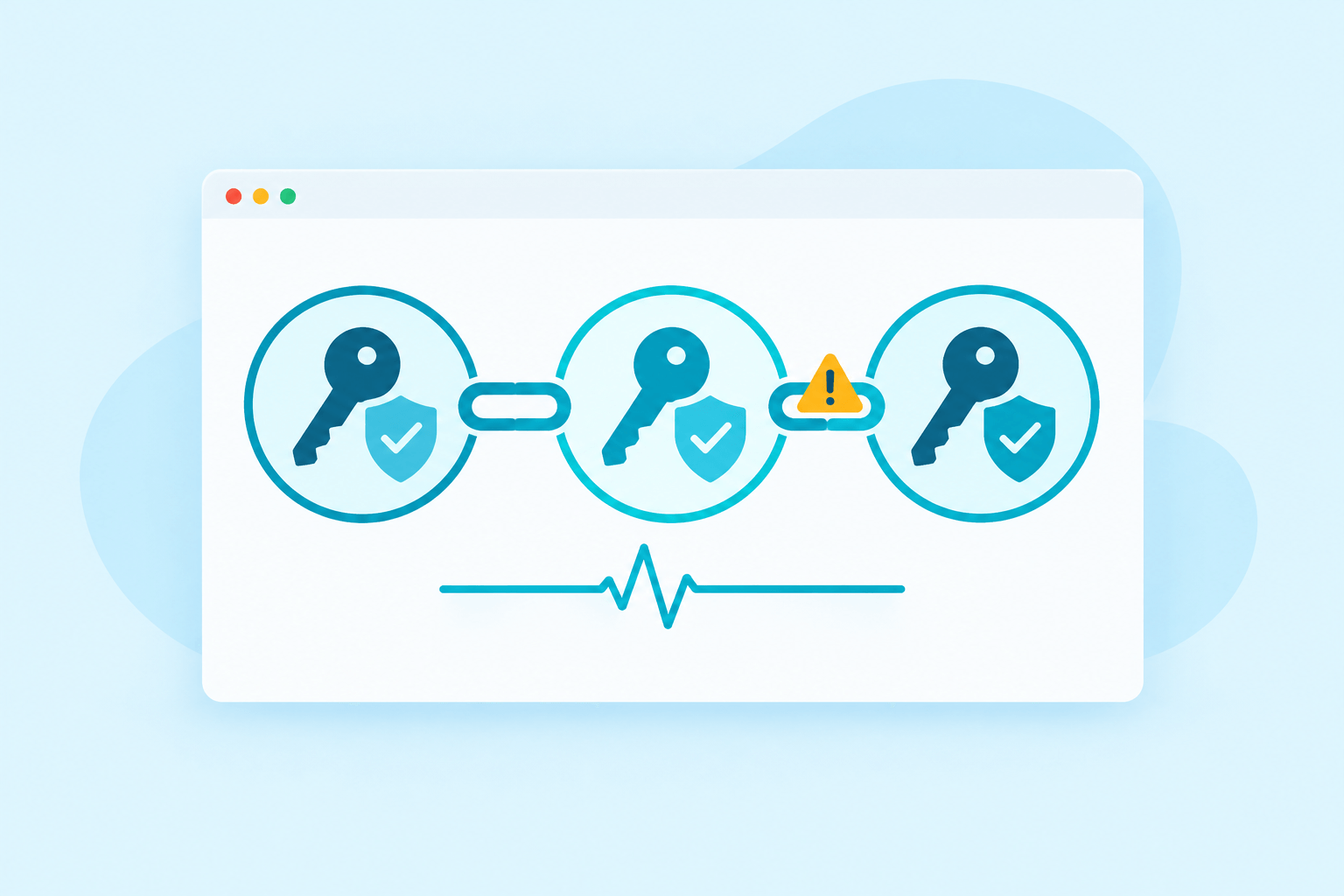
DNS translates a domain name, such as example.com, into the technical records that browsers and other clients need. For signed domains, DNSSEC adds a chain of cryptographic signatures to that process. A validating resolver checks that the answers it receives are authentic and have not been tampered with.
You can think of it as a chain of trust:
- The root zone signs its own records, including records that point to the keys of signed top-level domains.
- A signed top-level domain can publish a signed record that points to the key of a signed domain below it.
- Each signed domain signs its own DNS records with its keys.
- A validating resolver checks that chain before accepting an answer.
Unsigned domains do not sign their own records, but they can still be affected when a validating resolver cannot verify the signed zones above them. A DNSSEC failure in a top-level domain can therefore make unsigned websites beneath it unreachable too.
If one part of that chain is wrong, expired, missing, or not trusted, a validating resolver should reject the answer. That is a security feature. But from a visitor's perspective, the result can look exactly like downtime: the domain does not resolve, and the site cannot be reached.
What happened to .de
On 5 May 2026, DENIC, the registry operator for Germany's .de top-level domain, started publishing incorrect DNSSEC signatures. Cloudflare wrote that validating resolvers receiving those signatures had to reject them and return SERVFAIL, including Cloudflare's public resolver 1.1.1.1. Cloudflare's incident write-up is here: When DNSSEC goes wrong: how we responded to the .de TLD outage.
The important lesson is not that millions of individual websites suddenly misconfigured their hosting. The problem was higher in the DNS hierarchy. A healthy .de website could still become unreachable for users whose resolver validated DNSSEC and therefore rejected the bad signatures.
During the incident, some resolver operators used a temporary mitigation called a Negative Trust Anchor. In simple terms, that tells the resolver to bypass DNSSEC validation for a specific zone while the upstream problem is being fixed. That can restore reachability, but it is a deliberate security tradeoff. It should be used by resolver operators who understand the risk, not by ordinary website owners as a general fix.
What happened to .al
Two months later, Cloudflare described a similar availability lesson for Albania's .al top-level domain. On 3 July 2026, AKEP, Albania's communications authority and the operator of .al, attempted a DNSSEC key rollover. The new key was published and the old one stopped being served while the root zone's record still pointed to the old key, so validating resolvers rejected affected answers. Cloudflare noted that the failure could affect .al domains regardless of where the sites were hosted or which authoritative nameservers served them. The full article is A broken DNSSEC rollover took down .AL.
Again, the hosting stack was not necessarily the problem. The failure was in the DNSSEC validation path. Users relying on validating resolvers could see errors even when the web servers themselves were still running.
Cloudflare also highlighted that clients may be unable to tell from a DNS response when validation has been bypassed. During the .al incident, 1.1.1.1 returned Extended DNS Error 33 on responses served while a Negative Trust Anchor was active. Tools that inspect these DNS responses can use that information during diagnosis.
What is planned for 11 October 2026
The root KSK is the trust anchor at the top of DNSSEC validation. KSK-2024 has been published in the root zone since 11 January 2025. The currently scheduled operational date is 11 October 2026, when the root zone starts using only KSK-2024.
If you operate a DNSSEC-validating resolver, do not assume automatic trust-anchor updates worked. Verify that KSK-2024 key tag 38696 is actively trusted by your resolver. Follow your resolver vendor's guidance rather than checking a seed file alone. For BIND with automatic key maintenance, rndc managed-keys status shows the live managed-key state.
Prepared resolvers and resolvers that do not perform DNSSEC validation are unaffected by this trust-anchor change. An unprepared validating resolver can eventually fail to resolve domains across the Internet, including unsigned domains. Failures may emerge as cached root keys expire, often during the following 48 hours. Timing varies with configuration and query activity; an idle resolver can encounter the change later, and a mix of prepared and unprepared resolvers can give users intermittent results. ICANN explains these timing differences.
If you do not operate validating resolvers, you usually do not manage the root trust anchor for your visitors. Their resolvers may be run by an Internet provider, employer, or public DNS service. Your hosting provider and authoritative DNS provider have different roles. If your organization uses a managed recursive resolver, ask its operator about readiness. For public visitors, be ready to identify affected networks and resolver operators when an incident occurs.
A practical readiness checklist
Start with ownership. If your company runs its own recursive resolvers, assign a named owner to verify KSK-2024 before the October date. If it uses a managed recursive DNS service, ask that operator whether its validating resolvers have the new trust anchor and how it monitors DNSSEC validation errors.
Then prepare your availability view:
- Monitor your public website from the outside, not only from inside your own office or hosting network.
- Check which resolvers your servers, containers, and applications use for outbound connections such as payments, email, and API calls. Confirm readiness with the resolver operator.
- Make sure the alert goes to someone who can act, not only to a shared inbox.
- Keep escalation contacts for your DNS provider, hosting provider, registrar, and network provider in one place.
- Prepare short incident notes that explain when the problem started, which domains are affected, and which resolvers or locations show the symptom.
- If you use a status page, decide in advance how you will describe a DNS-level reachability incident without overclaiming the root cause too early.
When an alert arrives, separate the symptom from the diagnosis. "Visitors cannot reach the site from these locations" is useful and verifiable. "DNSSEC is broken" may be true, but it needs DNS evidence from resolver logs, authoritative DNS checks, or a provider investigation.
Where Semonto fits
Semonto's website monitoring checks your site from external test locations. It can reveal reachability failures at those locations, alert your team through notifications, and help you track the incident with issue management and communicate through status pages. Server health monitoring provides a separate view of host health, depending on how the check is configured.
Reachability results reflect the resolver path used at each test location. A DNSSEC problem affecting a different resolver may not appear in those checks, and a passing result cannot certify readiness for every visitor. Semonto's website monitoring does not perform a dedicated DNSSEC or root trust-anchor audit. Use dedicated DNSSEC diagnostics and the relevant operators' tools to verify signatures and resolver readiness.
Semonto's Domain Monitoring tracks registration-related domain information. DNSSEC resolver readiness is a different operational topic.
The main takeaway
DNSSEC is there to protect users, but validation failures can look like downtime. The .de and .al incidents in 2026 showed that even well-maintained websites can become unreachable when something breaks higher in the DNS chain.
Before 11 October 2026, resolver operators should verify KSK-2024 key tag 38696. Website owners should make sure they have outside-in reachability monitoring, useful escalation contacts, and a communication plan. You may not control the root key, but you can control how quickly you notice, how clearly you escalate, and how calmly you explain the impact.
Latest blogs

Tips and Tricks
Let’s Encrypt’s 64-day certificates: check your renewal setup
Tips and Tricks
Chrome 154 will ask before HTTP: audit your forgotten URLs now
Tips and Tricks