TLS/SSL Certificate Monitoring
Monitor TLS/SSL certificates to prevent HTTPS errors, browser warnings, and SEO trust loss. Get alerted early so you can renew before users or search engines see an issue.
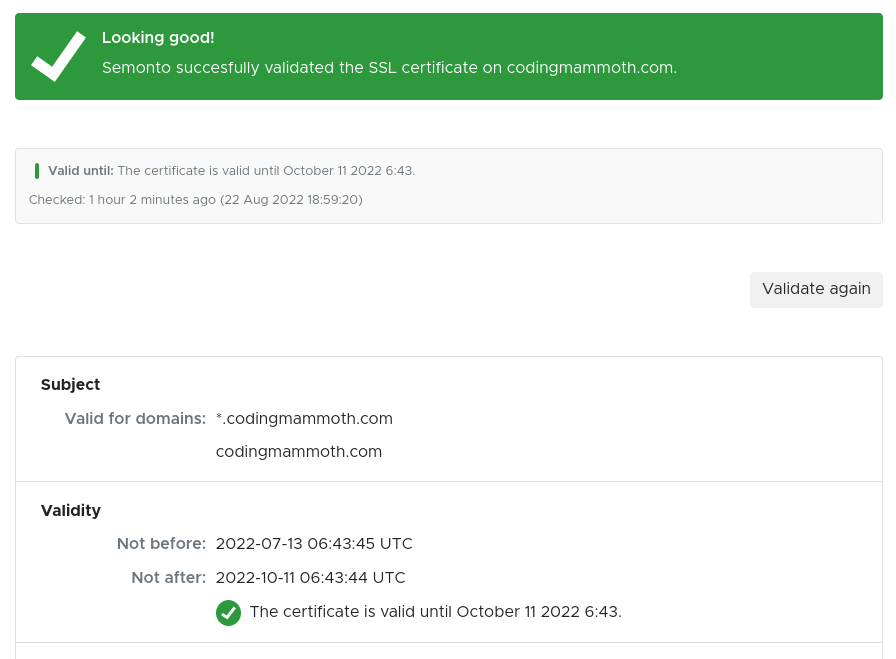
Protect SEO trust with valid certificates
An SSL/TLS certificate (also called an HTTPS certificate) proves that the connection between your web server and visitors is encrypted and trusted. When a certificate expires or is misconfigured, browsers show security warnings, users abandon sessions, and search engines may reduce trust or stop crawling pages that fail HTTPS. TLS/SSL certificate monitoring keeps your site crawlable and trusted by alerting you before issues appear so you can renew or fix the certificate in time.
How SSL errors hurt SEO, trust, and conversions
HTTPS failures create browser interstitials, broken API calls, and blocked resources. That hurts user trust and drives abandonment, while search engines can struggle to crawl or index pages that return TLS errors. Preventing HTTPS issues protects rankings, conversions, and brand credibility.
Common SSL failure scenarios we monitor
- Expired certificates that trigger "Your connection is not private" warnings.
- Hostname mismatch or wrong SANs after a certificate rotation.
- Incomplete chains (missing intermediate certificates) that break trust.
- Revoked certificates flagged by OCSP/CRL checks.
Mixed HTTPS environments and resource warnings
Even with a valid certificate, mixed content (HTTP images, scripts, or iframes) can trigger warnings or block resources. That weakens security signals and hurts UX. Use mixed content monitoring to keep all assets secure.
Short-lived certificates and rotation risks
Short-lived certificates require reliable automation. A failed ACME challenge, a DNS change, or a staging certificate pushed into production can break HTTPS overnight. Semonto alerts you to rotation failures and staging leaks before they turn into user-facing errors.

Ivo Boeykens
founder of akapivo bvba
Semonto informed us that our SSL certificate was about to expire. This was unexpected because we have automatic renewal via Let's Encrypt. Since we force the use of https, our site was guaranteed to go offline. Semonto gave us a warning in advance, and a certain crisis was prevented!
Why you need TLS/SSL certificate monitoring
To avoid security warnings
If you forget to renew your SSL certificate, your website or webshop will be flagged. Visitors will get a message that 'the connection is not private' or 'this website is not secure'. Not exactly a good first impression. By renewing your certificate in time, you make sure that your visitors are never scared away by these alarming messages.

To double-check automatic renewal scripts
We send you a reminder when your SSL certificates are about to expire. Because even if you have enabled automatic renewal scripts, something can still go wrong. Don't wait until your SSL certificate has expired. Use Semonto to stay ahead of problems.

To check against the certificate revocation list
Even if your certificate expiry date has not yet been reached, your SSL Certificate can be revoked remotely for other reasons. The Online Certificate Status Protocol (OCSP) keeps track of all certificates that were revoked. Semonto double-checks with the OCSP to make sure that your certificate has not been revoked and that your SSL Chain is valid at all times.

Prevent your (web)apps from being broken
Apps quite often use an API where the communication also is over https to protect the users privacy and security. If the certificate expires the users privacy and security might be compromised or the app could fail to work. Make sure to monitor those too.
Get notified of any SSL issue
The expiry date is not the only thing to keep an eye on. There is a validation chain that runs all the way from the root certificate to your domain certificate. Any error or expired element in that chain can cause your SSL certificate to fail. Your certificate can also be revoked, even if your expiry date has not been reached. Semonto takes all these factors into account and lets you know when action is required.
What you can expect
 Instant notifications when an issue is detected
- Continuous validation of SSL certificate expiration dates
- Checks your SSL chain
- Checks via Online Certificate Status Protocol (OCSP) for your certificates and chain
- Be notified when your SSL certificate is about to expire, so you can react in time
Get started in minutes

Get started
TLS/SSL certificate monitoring is available on all our plans. Each website or server that you start to monitor will have validation of the certificate enabled by default.
Get notified
We will send you notifications how you prefer, via email, SMS, push notifications and more. You will be notified before one of your SSL certificates has expired so you can react in time. The first alert will be 14 days before it expires and if you haven’t renewed the certificate you will receive another alert 5 days before it expires.


Get confident
You do not need to remember expiration dates anymore. No need to wake up in the middle of the night wondering whether you renewed your certificate in time. Semonto will let you know.
Easy management
Semonto provides you with an overview of all the TLS/SSL certificates you monitor so you can quickly see which certificates are about to expire or have other configuration issues.

Tests from multiple locations
Semonto performs the same tests from multiple locations to avoid false positives. In other words, we get a ‘second opinion’ before alerting you. If your server is down in one location (for example, Amsterdam) we verify the result by testing again from a second location (for example, New York). Only if both test locations confirm the problem, we send out an alert. If you want, you can go even further and specify how long we should wait before notifying you for each test.
Our testing locations:
- •Amsterdam (The Netherlands)
- •Frankfurt (Germany)
- •New York (USA)
- •San Francisco (USA)
- •Bangalore (India)
Generate a website performance report
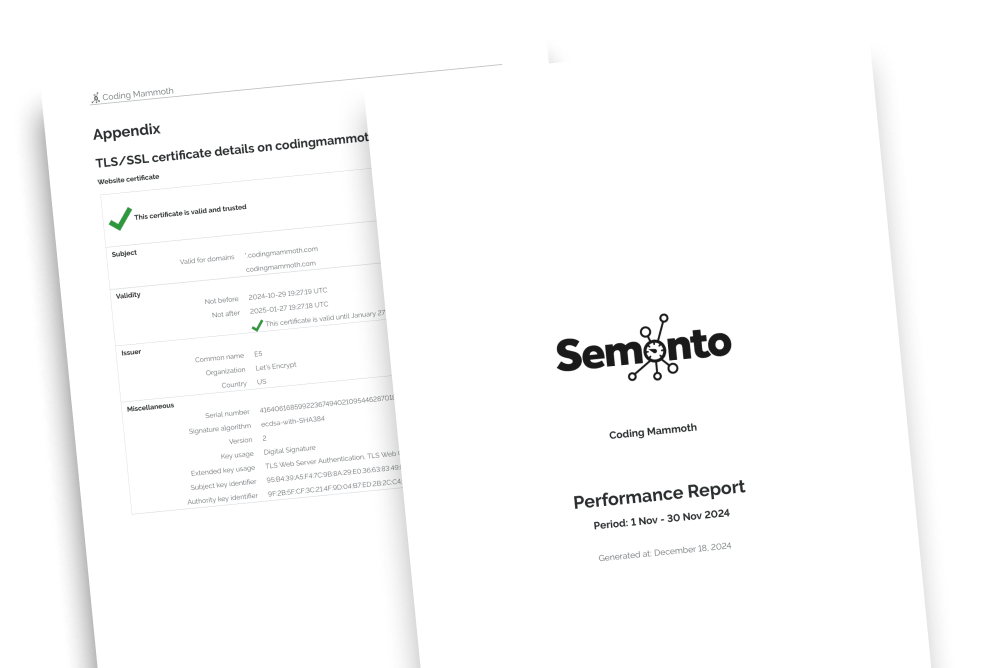
In Semonto, you can generate a PDF report with clear graphs and metrics to showcase the validity of your SSL certificate and renewal dates. This document is perfect for sharing with clients, team members, or stakeholders—no manual effort is required! Combine any tests you want and turn your data into a professional, easy-to-read document. And the best part: it’s white label, so you can present it as your own.
TLS/SSL certificate monitoring is perfect for:
Web professionals
Do you build websites for your customers? Make sure that you are notified in time when their SSL certificate will expire or is revoked so you can avoid warning messages on your websites.
SEO teams
HTTPS errors can break crawlability, trust, and conversions. Keep certificates healthy so your SEO work does not get derailed by security warnings or blocked pages.
Server Owners
Semonto keeps an eye on your servers and the websites you are hosting. We ensure that all your certificates are renewed in time so your websites are always reachable and you can keep your reputation high.
Webshop owners
As a webshop owner, you want to avoid cart abandonment at all cost. Research shows that online shoppers will change their mind about their purchase if the connection is not secure. Use Semonto to monitor your SSL certificate and keep your webshop secure at all times.
You might also be interested in

Website Monitoring
Get alerted immediately when your website is unreachable or slow to respond. This way, you can fix the issue before anyone else notices.

Server Monitoring
Test the availability of your business-critical servers. If something affects their performance, Semonto alerts you immediately so you can respond quickly.

Mixed Content Monitoring
Prevent insecure resources from sneaking into HTTPS pages and keep security warnings away.
Trusted by companies who take their website seriously